Rego rule editor
Monaco-based editor in the compliance console. Live test runs against sample inputs.
Six Rego policy packages cover access, suitability, restricted lists, AML, AI actions, and data access. Compliance officers edit rules in a Monaco editor, run tests, and deploy through the same CI as the rest of the platform.
The compliance context owns rule definitions, evaluation, and case lifecycle. Rules are not buried in service code; they live in infra/opa/policies/ as Rego packages, are tested by opa test in CI, and are versioned through the same release pipeline as the application code. Six packages ship: access (RBAC), suitability, restricted_list, aml, ai_actions, and data_access.
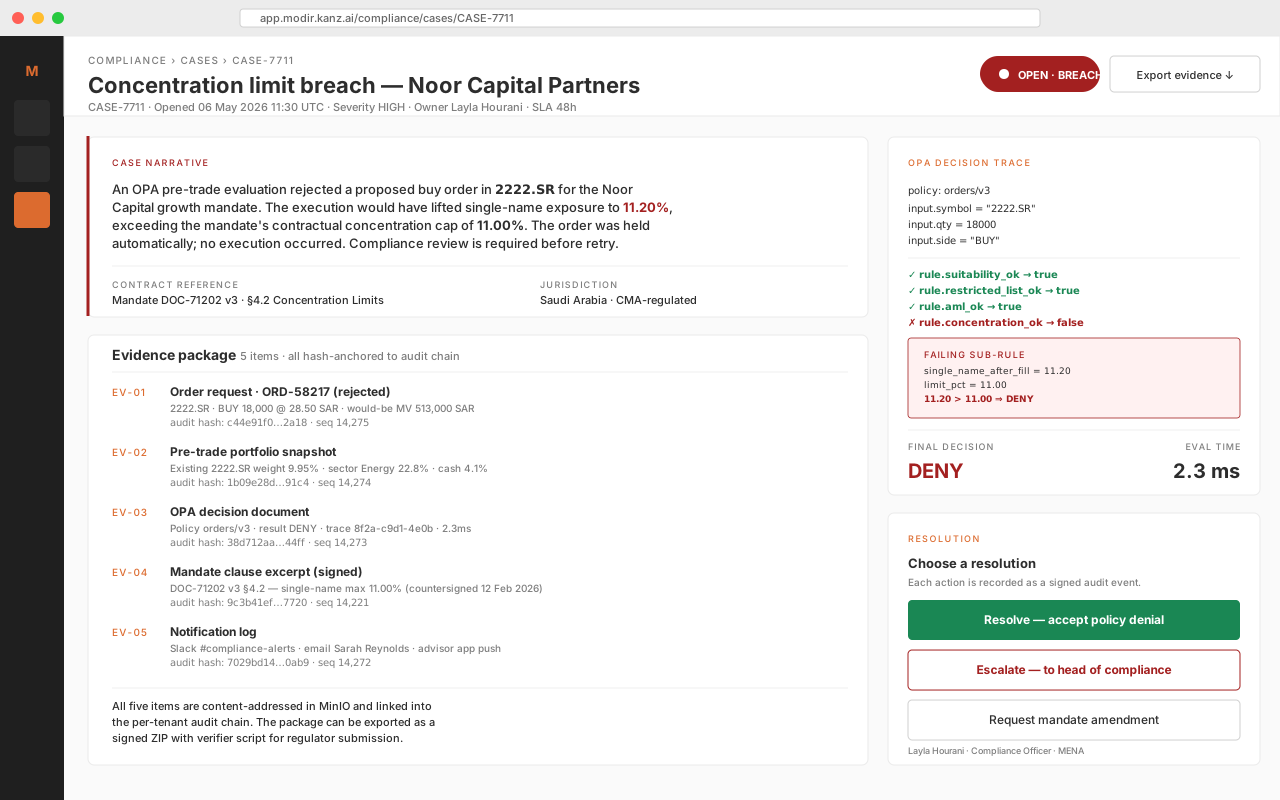
Cases are structured records of breaches and reviews. Each case has a severity (low / medium / high / breach), a state (open / under_review / pending_action / closed), and a typed payload with the original triggering event, the policy decision, and the supporting evidence. Cases participate in the caseManagementWorkflow in Temporal, which runs SLA timers and auto-escalates up to three times before paging a human.
Restricted-list management is per-tenant and per-jurisdiction. Lists are versioned, with effective-from / effective-to ranges; OPA queries the active version at decision time. Adding an instrument is a UI action that produces a Git-tracked Rego data file via the API — every change has an author and an audit event.
The compliance console (web-compliance) is a dedicated Next.js application: audit explorer, case queue with assignment, and the embedded Monaco-based Rego rule editor. Officers run opa eval from the editor against a sample input before deploying; the deploy runs the same way the engineering team’s Helm rollout does.
| Package | Concern | Inputs | Decisions |
|---|---|---|---|
| access | Base RBAC, scope gates | subject role, action, resource type | allow / deny |
| suitability | Risk tolerance vs instrument risk | client risk tier, instrument risk class, account allocation | allow / warn / deny + reason |
| restricted_list | Symbol-level blocks | symbol, tenant + jurisdiction lists | allow / deny + match |
| aml | Cash, structuring, jurisdiction | amount, history, residency, counterparty | allow / warn / deny + flag |
| ai_actions | Gate AI mutations | actor role, AI use case, target resource | allow / require_approval / deny |
| data_access | RAG chunk filtering | subject relationships, chunk metadata | allow / deny per chunk |
package modir.suitability

import future.keywords.if
import future.keywords.in

# Allow: instrument risk does not exceed client tolerance.
allow if {
  input.instrument.risk_class <= input.client.risk_tolerance_score
}

# Warn: one band higher than tolerance.
warn[reason] if {
  input.instrument.risk_class == input.client.risk_tolerance_score + 1
  reason := "instrument is one risk band above client tolerance"
}

# Deny: more than one band higher.
deny[reason] if {
  diff := input.instrument.risk_class - input.client.risk_tolerance_score
  diff > 1
  reason := sprintf("instrument is %d bands above client tolerance", [diff])
}

# Concentration override: any single position must remain <= 10%.
deny[reason] if {
  pct := (input.position.notional + input.order.notional) / input.account.market_value
  pct > 0.10
  reason := sprintf("post-trade concentration would be %.1f%% (max 10%%)", [pct * 100])
}Case created automatically (policy breach) or manually (analyst report). Severity assigned by triggering event.
Compliance lead reviews; assigns owner; sets target SLA based on severity. AI triage suggests a category.
Owner gathers evidence, links related cases, requests information from advisor. Every action audited.
Outcome decided (no action / advisory / restitution / escalation). Action assigned to operations or advisor.
Closure note required. Case becomes part of audit evidence; included in regulator-ready exports.
Monaco-based editor in the compliance console. Live test runs against sample inputs.
Per-tenant, per-jurisdiction; versioned with effective ranges.
Auto-assigned by team policy; SLA timers; up-to-three escalations.
Filter by tenant, actor, action, time. Open evidence files in-place.
Regulator-ready, byte-reproducible, with a verification script.
periodicReviewWorkflow daily; suitabilityReviewWorkflow annual.
Bring a recent breach. We will reproduce it as a case in Modir, with policies, evidence, and signed export.